Can AI Help Personalize Cancer Care?
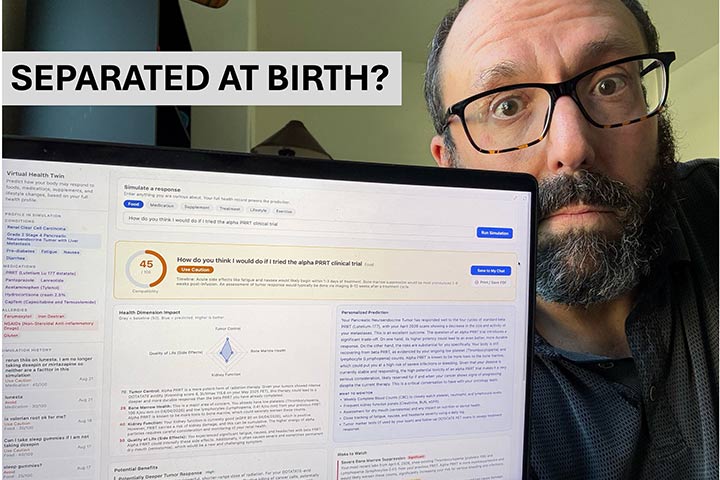
Meet Burt Rosen’s digital twin.
When Let’s Win first spoke with Burt Rosen, who has a pancreatic neuroendocrine tumor—among other things—about artificial intelligence, he was using ChatGPT to translate scan reports into plain English, organize medical records, analyze symptom trends, and prepare thoughtful questions for his doctors. He used it as an advisor, a clarifier, a simplifier, and a research assistant.
Now he wants to take things a step further. Rather than simply asking AI to explain his health, Rosen wants AI to understand enough about him to help explore what could happen next. “I’ve been obsessed with the idea of building a digital twin to test treatment hypotheses before trying them on myself,” he says.
His goal is an evolving virtual representation that brings together not just his diagnoses, scans, and blood work, but also his treatment history, medications, symptoms, lifestyle, and personal priorities. In theory, he could then use that information to explore what-if scenarios before making decisions in real life.
What Rosen has today is an early experiment toward that vision, rather than a clinically validated tool for predicting treatment response. And Rosen himself is careful about that distinction. “Right now I look at it as input,” he says. “It’s certainly not an ending point yet, but it’s a great starting point.”
Testing a Treatment Scenario
One of Rosen’s first experiments focused on alpha peptide receptor radionuclide therapy (alpha PRRT), an investigational treatment for neuroendocrine tumors.
He had been using Claude and the patient-facing AI platform My Doctor Friend to gradually build up a detailed picture of his health through scans, blood work, symptom tracking, and countless conversations about his diagnoses, treatments, and day-to-day health.
Then he posed a new question to a system that already knew him well: What might alpha PRRT mean for me?
The resulting analysis drew on that accumulated history, including his previous beta PRRT treatment, platelet and lymphocyte counts, kidney function, clear cell renal carcinoma diagnosis, and prior treatment response. It outlined potential benefits and risks, areas of uncertainty, and factors that might warrant monitoring or further discussion with his medical team.

That longitudinal context is central to Rosen’s idea of a digital twin. He doesn’t want to repeatedly feed an AI platform a handful of facts every time a new treatment question arises. He wants an evolving model that already knows his medical history and can apply that knowledge when something new comes along. “Most current medical options are presented to us because of population health statistics,” Rosen says. “My desire is to see how something might impact Burt.”
Using AI to Create Personalized Guidelines
Modern cancer care rests on evidence generated from groups of patients. Clinical trials help identify which treatments work, for whom, and at what cost in terms of side effects. Evidence-based guidelines, including those developed by the National Comprehensive Cancer Network (NCCN), help physicians put that knowledge into practice. Doctors then have to apply that evidence to the individual sitting in front of them.
Rosen wonders whether AI could eventually help take that individualization much further. “A lot of healthcare is really treating population health,” he said in a recent NETCast podcast discussing AI in healthcare. “Where AI is really going to transform everything is it’s going to take it down to the individual level.”
He imagines an AI system that knows not only his scans, blood work and treatment history, but also things that may never appear neatly in an oncology chart: what he eats, how active he is, his stress levels, his environment, and what matters to him. “I’m looking for an NCCN for one, instead of NCCN for all,” he says.
It is an ambitious vision. It is also one that pushes far beyond what patient-facing AI can reliably do today. And My Doctor Friend founder Michael Turken, M.D., M.P.H., believes Rosen is pointing toward an important shift in how patients may use these tools.
From Dr. Google to Patient-Operated Healthcare
Turken is a practicing internist at UCSF Health in San Francisco, California, as well as a former clinical specialist at Google Search, which gives him an unusual vantage point on an old healthcare habit.
Long before ChatGPT, patients routinely consulted “Dr. Google” about symptoms, test results, and diagnoses. Generative AI takes that behavior to another level. Instead of typing a few words into a search engine and sorting through links, patients can hold an ongoing conversation, provide medical history, upload results, and ask increasingly personalized follow-up questions.
Turken watched his own patients begin doing exactly that. Rather than telling them to stop, he became interested in how it could be made more useful—and safer. “We must assume people are going to use these AI chatbots; to think otherwise is willful blindness,” he says. “The job is not to shame people for seeking information or pretend that they will stop doing it. The job is to design for that behavior.”
It’s part of what he hopes will become a movement towards patient-operated healthcare. That does not mean patients replacing doctors. Rather, it starts with recognizing how much healthcare work patients and caregivers already do without a clinician in the room.
As pancreatic cancer patients know all too well, a diagnosis can come with a second, unofficial job: tracking symptoms, managing medications, collecting records from multiple specialists, preparing questions, and trying to remember what one doctor said well enough to repeat it accurately to another.
“For some people, managing their health is almost like a full-time job,” Turken says. “They deserve more than just a patient portal and a notebook.”
AI, he believes, could eventually provide some of that missing infrastructure, helping people organize their information, triage their symptoms in a more informed way, and become more empowered as advocates for their own health. “To get the best of the healthcare system, we often need to perform better as patients,” he notes.
Building with Patients, Not Just for Them
Rosen’s and Turken’s collaboration worked in both directions. Turken brought his medical and technology experience to Rosen’s digital-twin experiment. Rosen, in turn, brought the perspective of someone living with serious illness and actively using AI to manage it.
That feedback has influenced Turken’s thinking about how patient-facing tools should be developed. He initially imagined My Doctor Friend partly as a way of making sophisticated AI easier for people without technical expertise to use. Patients such as Rosen have shown him that some want to go further: They want to help create tools around their own needs.
“I would like to create a tool to enable everyone to be more like Burt in their care, without having to be incredibly tech savvy,” Turken says. For Rosen, that kind of partnership also matters. He does not expect to hand responsibility for his care to the digital twin.. It is another tool he can use to ask better questions.
And that distinction becomes especially important when the answers come from AI.
Asking AI: “Why Might You Be Wrong?”
Both Rosen and Turken stress that AI output should not be mistaken for medical fact. Generative AI can be extraordinarily convincing when it is wrong. It can also be overly agreeable, picking up cues about what a user wants to hear and providing reassurance that may not be warranted.
Turken therefore encourages his patients to challenge it. One of his favorite prompts is remarkably simple: Why might you be wrong? He also encourages members to ask what additional information could change the answer, and to bring important conclusions back to healthcare professionals.
That is particularly relevant to something as ambitious as Rosen’s digital-twin project. A model can organize his existing information, identify factors that may matter, and generate questions or scenarios. That is different from proving that it can accurately forecast what his cancer—or his body—will do after a particular treatment.
For now, Rosen sees value in the thinking process itself. Ultimately, he wants an AI care coordinator that knows much more than what medications he takes and what surgeries he has undergone. “I’m looking for AI to be my true care coordinator, the one entity that knows everything about me outside of myself and my wife,” he says, including “what I do for fun, what my energy level is, what my sense of humor is like.”
He even imagines a future when that increasingly complete picture could contribute to therapies designed specifically around an individual. “I dream of a day where it knows enough about me that it can design a medication specifically built for me, based on my side effects, my symptoms, my lifestyle, my diet. And possibly even make it at home in a modified 3D printer.”
That future is not here yet. But Rosen is less interested in waiting for it than in exploring, cautiously, what today’s tools can already add.
Patient-Facing AI Is a Growing Field
My Doctor Friend is one of a growing number of tools exploring ways to combine AI with personal health information. Other examples include Guava, ChatGPT Health, Claude’s personal health integrations and Verily Me. Their capabilities differ, and the field is changing rapidly. Some focus on organizing medical records and tracking symptoms; others help users interpret health information or prepare for medical appointments.
Patients considering these tools should look carefully at issues including privacy, data use, cost, clinical oversight, and what the product is—and is not—designed to do.
Recent Stories

A Very Lucky Man

Confirming the Link Between New-Onset Diabetes and Pancreatic Cancer