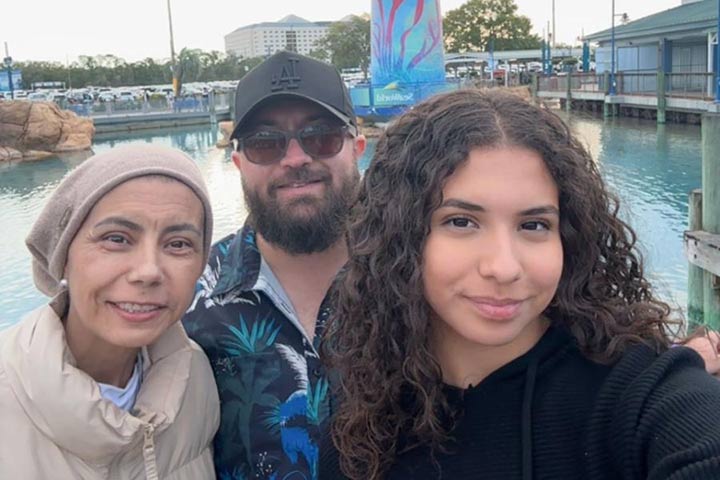
Updating My Story: Daraxonrasib Is Making a Difference
- Recurrence a year after my Whipple surgery
- Chemo and radiation helped temporarily
- Taking daraxonrasib
When I first told my story in April 2025 I was doing well.
I had a Whipple procedure in August 2024 and had been in remission since December 2024.
But in August 2025 I started having intense pain. I was losing weight and felt very ill. I went to my doctors at Sylvester Comprehensive Cancer Center (Miami), who did several tests. The results showed that there was a recurrence in my pancreas.
I was given eight cycles of gemcitabine, and then went to Dr. Michael Chuong at Baptist Health for radiation treatment. The radiation was very strong, with harsh side effects, including constant fatigue, vomiting, total hair loss, among other things. But my CA 19-9 level decreased and I remained stable for about three months. However, when I had a PET scan, it showed that I had metastases in my liver and lungs, and my CA 19-9 level was very high again at 1,150.
Next Step: Daraxonrasib
Dr. Peter Hosein prescribed daraxonrasib as part of the FDA’s Expanded Access Program. I started on June 25th, and the drug was approved by the FDA a few weeks later. Thank God, I’ve already seen a great improvement. My CA19-9 is currently at 39, and the report from my last PET scan says that the metastases have disappeared.

I have side effects—sometimes I have a lot of fatigue, and there are days of nausea—but never compared to what I felt with chemo. I also got a rash on my face, but the doctors gave me a cream that helps a lot. In general, it doesn’t bother me that much because it is not something that affects my health, it’s just my physical appearance. I still have ascites (fluid buildup). About every two or three weeks I have to have a paracentesis, where they remove an average of three liters of fluid from my abdomen.
The pills were delivered to me without any problems. I started taking 300 mg every day, then I lowered it to 300 one day and 150 the next, and I continued like that for some time. Currently I am taking 200 mg daily. My next check-up is on October 7th to see how the results are going with this lower dose.
My Status
Daraxonrasib has worked very well for me—my recovery on it has been a miracle. I continue to receive care at Sylvester. Dr. Hosein and his team are excellent; their guidance and help is extraordinary.
Through health insurance, everything has worked well for me, even though the price for this drug is listed at $40,000 per month. But I am very concerned about people living in other countries who don’t have access to this medication and need it to survive.
I am very interested in having the support of many kind-hearted people, who with a simple message can lift your spirits in difficult times, and also in helping and guiding patients and families who are going through this same disease, about which little is known and which causes so many questions and uncertainty.
Please follow me on my Instagram account at @catafandiq
Recent Stories
A New Era
One Year Later