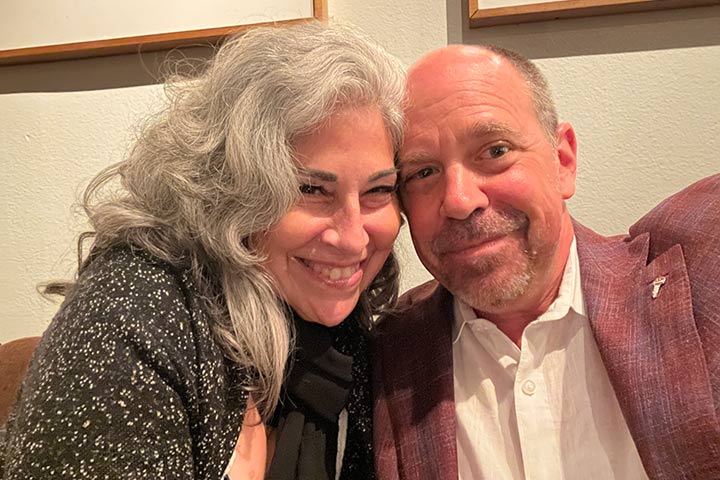
A Very Lucky Man

- Weight loss and jaundice led to stage IV diagnosis
- Chemotherapy with FOLFIRINOX
- Compassionate use of investigational treatment Saltikva
- SBRT for a recurrence
I am a very lucky man.
Lucky to have had good parents and a good education, to have been born when I was, with a father who survived D-Day, and to have a good wife. Now, at 74 and almost three and a half years after being diagnosed with metastatic pancreatic cancer, I’m lucky to feel good most days and do everything I want to do.
The One in the White Coat
For most of my life, I was the one in the white coat. Thirty-some years as a urologist teaches you a confidence about hospitals—you know the hallways, the language, and assume you’ll always be on the clinician’s side. That held until spring 2023, when I started losing weight without trying, then lost my appetite almost overnight. Sixty pounds gone. I knew enough to be worried before anyone said a word.
Shortly after, I saw my doctor. She noticed my eyes were yellow and admitted me to the hospital that day. Imaging showed a 3.3 cm tumor obstructing my common bile duct, and a biopsy confirmed pancreatic cancer. I went to the Mayo Clinic, where a laparoscopy showed the cancer had already spread to the peritoneum. I came home to my oncologist in Minneapolis and started FOLFIRINOX chemotherapy. The average survival was about eight months. My wife and I met with a palliative care doctor and updated our wills.
Referred to a Clinical Trial by . . . a Veterinarian?
The rest of my treatment came to me in an unlikely way. In July 2023, my wife took our dogs to the vet, who asked how the family was doing. When she told him about my diagnosis, he grew emotional and told her about a drug used in dogs with osteosarcoma that was now being studied in people with pancreatic cancer. I looked it up that night, found encouraging phase II results for a therapy called Saltikva, from the company Salspera, and emailed the founders. I was approved for compassionate use—an investigational treatment, not a formal trial. I receive Saltikva through the company’s expanded access program, taking it orally after every chemo infusion, with no added side effects.
Drawn to the Science
As a retired urologist, I was drawn to the science of this emerging treatment. Saltikva is a nontoxic, engineered strain of Salmonella that concentrates in pancreatic cancer cells and prompts them to produce IL-2, a molecule known to fight cancer. I remembered IL-2 from early in my career, first used against metastatic kidney cancer, given intravenously in large, toxic doses, though a few patients were cured. Concentrating it inside the tumor itself, instead of flooding my whole body, caught my attention. It didn’t feel as strange as it might to some—urologists have used a weakened bacterium, BCG, against bladder cancer since around 1980.

I had chemo every two weeks at first, and recently every three. I’ve been fortunate to tolerate it well. For about four days after each infusion, I have little appetite and feel tired, then return to normal—working in the yard, relaxing by the garden and koi pond, still enjoying a Klondike bar most nights. We travel about six times a year, and every three months I have a short procedure, an ERCP, to keep my biliary stent clear. Because of this treatment, I’ve seen the birth of a grandson—I never knew a grandfather myself, so that has meant a great deal.
Normal Scans
Within eight months of starting, my scans and tumor markers were normal, and my original tumor could no longer be found. In August, a 1 cm tumor appeared in the same spot, with no sign it had spread, and I began five sessions of stereotactic body radiation therapy (SBRT) on September 8.
My oncologist recommends that I stay on my current chemotherapy and Saltikva unless the disease progresses. I can’t say how much of my good fortune belongs to the chemo, how much to Saltikva, and how much to luck—only that I’ve had far more time than the eight months I was given, and more than seemed possible a decade ago.
Grateful for More Good Years
With metastatic pancreatic cancer, I know I’m not cured, and I will eventually lose this fight. I have no interest in aggressive treatments that might buy a few more months at a steep cost to how I feel day to day. But I am, genuinely, a very lucky man—grateful for more good years than I expected, and for the chance to tell this story in case it helps someone else navigating the same diagnosis.
Recent Stories

Confirming the Link Between New-Onset Diabetes and Pancreatic Cancer
Let’s Talk About Rasonque: a Q&A for Our Community