Very Fortunate
- Yellow skin led to diagnosis
- Family history but unclear if it is a factor
- FOLFIRINOX
- Whipple procedure
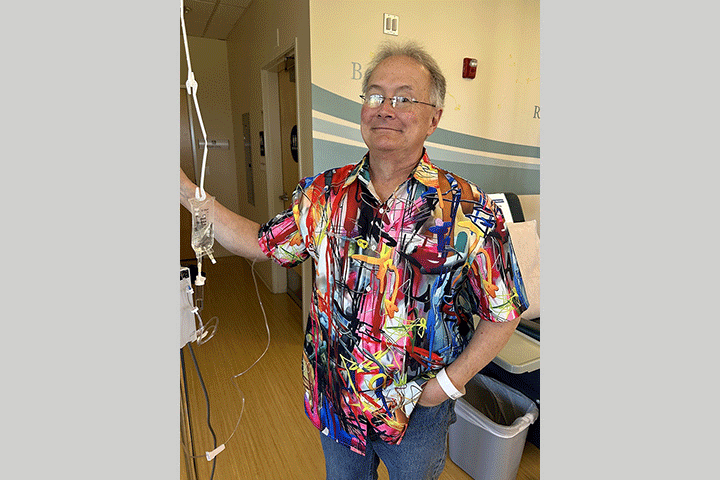
My name is Mike Duffy. I’m 70 years old, and I live in Sebastopol, California, a rural area in the northern part of the state.
My oncologist is Dr. YaoYao Pollock of Providence Medical Group, in Santa Rosa. I get most of my treatment at their Round Barn Cancer Center, although my Whipple surgery was performed at UCSF Health in Mission Bay by Dr. Carlos Corvera, who heads their pancreatic surgery program. I work as a software engineer at Electronic Arts.
Waking Up with Yellow Skin
I woke up on February 4, 2025, and noticed my face and chest had turned a pale yellow. I went off to see my primary care physician, who diagnosed adult painless jaundice as the cause. In most of these cases (70 percent of the time), that diagnosis indicates pancreatic cancer. What followed was a CT scan and an MRI, along with blood tests.
The CT showed a tumor on the head of my pancreas that had grown enough to pinch my biliary duct, resulting in jaundice. On February 7th, I underwent an oral endoscopy to biopsy the tumor and place a biliary stent. The biopsy confirmed that the tumor was an adenocarcinoma. The stent took care of my jaundice.
Starting Treatment
Since I was considered healthy enough to deal with the side effects of an aggressive treatment regimen, I started neoadjuvant (preoperative) chemotherapy using FOLFIRINOX on February 19th. I am not participating in any clinical trials, although Providence has an active clinical trial program.

I did have both serum- (blood sample) and swab-based genomic testing done, which showed a PALB2 gene. This is a variation of unknown significance, which means that there isn’t enough clinical data to determine a causal link from the gene to cancer. My father and half-nephew both died from pancreatic cancer, so there probably is some genetic factor in play.
Overall, I have been extremely fortunate and have tolerated treatment well. My pancreatic tumor was detected early. It did not appear on any scans when I had my appendix removed in August 2018, so it developed into a 1.8 cm mass over about six years. A PET scan showed that the tumor was localized, and its placement indicated that the tumor was resectable (i.e., could be removed via surgery).
A Full Whipple
Following six two-week cycles of FOLFIRINOX, I underwent surgery at UCSF Mission Bay on June 18th. I had open surgery, so I now have a lovely scar from my sternum to slightly below my navel.
Once inside, Dr. Corvera decided to perform a full Whipple procedure, rather than a modified, pylorus-preserving procedure which leaves the stomach intact. He removed about 20 percent of my stomach and 35 percent of my pancreas. The surgery was more involved than expected, and took about six and a half hours, mainly because the tumor was inconveniently positioned behind the superior mesenteric vein. One interesting detail is that when he finally was able to access the tumor, it fell off rather than needing to be dissected out!
I was in the hospital for seven days following surgery and came home pain-free and without any surgical drains.
Pathology
The pathology of the 30 lymph nodes removed from my abdomen showed that the tumor was localized (i.e., it had not spread to my lymph nodes). Although the edges of my tumor showed a margin of 1-2 mm, that is below the 5 mm margin that is considered “clean”. So, my tumor got an R1 rating. Again, I am fortunate to have had a really positive surgical outcome.
Due to the R1 rating, my case was reviewed by the UCSF tumor board. There was no clear agreement about doing both chemotherapy and radiation. We discussed the pros and cons, and for the moment have delayed making any decision regarding radiation.
Post-operative
Following surgery, I have not become diabetic due to insufficient insulin production, nor have I needed pancreatic enzyme replacement due to the reduced size of my pancreas. Again, very fortunate. Ten weeks after surgery, I felt pretty much back to normal, as my internal plumbing adjusted to its rearrangement.
I had another six rounds of adjuvant (postoperative) chemotherapy. Although I worked during my first six rounds, I went on a medical leave of absence since my surgery. Surgery does take a lot out of you, and the addition of chemotherapy to deal with made it time to take a break from work. Fortunately, my employer provides great benefits. I don’t plan to return to work until the new year.
I finished all six rounds of adjuvant FOLFIRINOX and rang the bell to mark the end of my treatment. I’m now transitioning to surveillance, with periodic lab work and scans. Since my surgery, my CA 19-9 tumor marker has been below 8 (normal range: 0-35). My goal now is to avoid a recurrence of cancer in the next two years: 70 to 80 percent of all recurrences occur within the first two years following treatment. My chances of long-term survival go way up if I make it through that window.
I’ve written about my adventure with pancreatic cancer from the very beginning. You can find it at This is not a drill if you’d like more details about my experience.
Recent Stories

An Immunotherapy Oddball

When Eating Isn’t Enough to Get the Nutrients You Need